Le Centre Canadien pour la Grande Guerre souhaite remercier les organisations et individus qui ont rendu possible cette exposition : Caitlin Bailey, Ada Chan, Javiera Segovina, Loïc Angot, et Angie Lumia, tous du Centre. Les familles Bradbury, Bernard et Goodleaf, qui nous ont partagé leurs histoires, et finalement la fondation de la famille Zeller, la fondation Jackman, et Patrimoine Canada.
Sources primaires
Bishop, Charles W. The Canadian YMCA in the Great War: The Official Record of the Activities of the Canadian Y.M.C.A. in Connection with the Great War of 1914-1918. Canada: The National Council of Young Men’s Christian Associations of Canada, 1924.
Burns, R. Easton. The Income War Tax Act 1917: A Digest (Toronto: Canadian Chartered Accountant, 1917). Archives and Special Collections – Morisset Library. University of Ottawa. Ottawa, Ontario, Canada. Accessed on June 20, 2018 from http://wartimecanada.ca/document/world-war-i/taxation/income-tax-1917.
Canada and Her Soldiers (London: St Clements Press, 1919). War, Memory and Popular Culture Archives. University of Western Ontario, London, Ontario, Canada. Accessed on June 20, 2018 from http://wartimecanada.ca/document/world-war-i/veterans-programs/our-pride-past-our-hope-future.
Department of Soldiers’ Civil Re-Establishment: Information and Services Branch, Ontario Offices: Important Information for Returned Men, n.d. [1918?]. War, Memory and Popular Culture Archives. University of Western Ontario. London, Ontario, Canada. Accessed on June 20, 2018 from http://wartimecanada.ca/document/world-war-i/veterans-programs/help-ontario-veterans.
Department of Soldiers’ Civil Re-Establishment: Information and Service Handbook for Members and Ex-Members of the Canadian Naval and Military Forces (1919). War, Memory and Popular Culture Archives. University of Western Ontario. London, Ontario, Canada. Accessed on June 20, 2018 from http://wartimecanada.ca/document/world-war-i/veterans-programs/information-ontario-veterans.
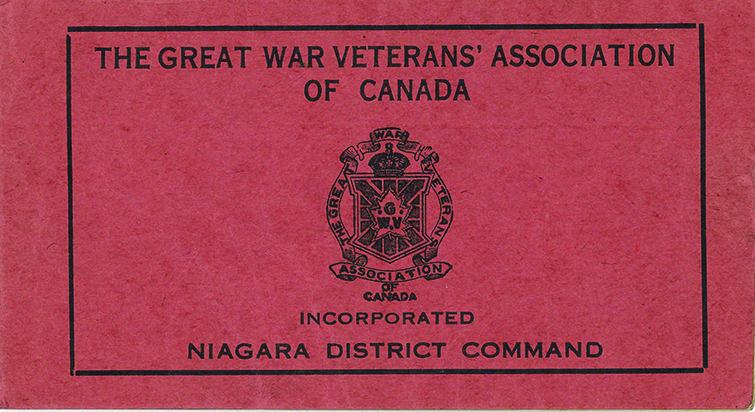
“Great War Veterans’ Association of Canada, Vancouver Branch: Rules and Regulations.” George Ormsby Fonds. Box 58A 1 153, Folder 20000013-002 to 010. Canadian War Museum, Ottawa, Ontario, Canada.
Great War Veterans’ Association: Statement re Eric Hollis’ Death. Army and Navy Veterans –Establishment of Home for Disabled Veterans. RG 13 Vol. 256. Establishment of Home for Disabled Veterans 480-500 1921, Folder 498/21. Library and Archives Canada, Ottawa, Ontario, Canada.
“Information on Pensions.” Percy Green Fond. Box 58A 1 236 15, Folder 20060103- 018. Canadian War Museum, Ottawa, Ontario, Canada.
“Khaki University of Canada for Soldiers of the Canadian Overseas Forces (September 1918).” Frank Dawson Adams Collection. MG1014 c.1. Service Overseas with the Khaki University, Folder 5. McGill University Archives, Montreal, Quebec, Canada.
Soldiers Settlement Act, 1919.
“The Canadian National Committee for Mental Hygiene: Report of a Survey made of the Organization in 1932.” Department of Finance. Box RG19 E2C. Canadian Mental Health Association, Folder 101-29-40. Library and Archives Canada, Ottawa, Ontario, Canada.
“The Pension Act.” Royal Canadian Legion (Great War Veterans’ Association of Canada). Box MG 28 I298 Vol. 74. Information Manual (Part 1): Print Matter, Government Regulations, Orders-in-Council, etc., on Issues Affecting Veterans (2) 1918-1922, Folder 74-7. Library and Archives Canada, Ottawa, Ontario, Canada.
Sources secondaires
Ashton, E.J. “Soldier Land Settlement in Canada.” Quarterly Journal of Economics 39, no. 3 (1925): 488-498. Accessed June 20, 2018. https://doi.org/10.2307/1882442.
Bernard, Dolores. Intervué par Caitlin Bailey. Entretien privé en regard à Colborne et Austin Bradbury. Calgary, Alberta, 27 juillet 2018.
Bowker, Alan. A Time Such as There Never was Before: Canada After the Great War. Toronto: Dundurn Press, 2014.
Carter, Sarah. “An Infamous Proposal: Prairie Indian Reserve Land and Soldier Settlement after World War I”, Manitoba History, np, Number 37, Spring/Summer 1999. Accessed August 15, 2018. http://www.mhs.mb.ca/docs/mb_history/37/infamousproposal.shtml
Goodleaf, Mouchie. Intervué par Caitlin Bailey. Entrentien privé en regard à Angus Goodleaf. Kahnawake, Québec, août 2018.
[1] Bien que peu mentionné, le CEF avait l’un des taux les plus élevés de maladies vénériennes au sein des Alliés. Les traitements pré-pénicilline comme le mercure, et le refus de l’armée de fournir de manière proactive une prophylaxie font que les maladies vénériennes constituaient un grand danger pour les familles des soldats de retour.
[2] Canada and Her Soldiers, 3.
[3] Charles W. Bishop, The Canadian YMCA and the Great War: Official Record of the Activities of the Canadian Y.M.C.A. dans Connection with the Great War of 1914-1918, 349.
[4] Ibid., 315.
[5] Bishop, 339.
[6] « Association des anciens combattants de la Grande Guerre du Canada, section de Vancouver: règles et règlements », 2.
[7] Association des anciens combattants de la Grande Guerre du Canada, « Déclaration concernant la mort d’Eric Hollis », 1.
[8] L’assurance d’une pension en cas de blessure a été clairement établie dès le début de la guerre, comme indiqué dans ce manuel de recrutement [Traduction] «[…] une pension sera accordée [aux] militaires blessés ou handicapés en service actif, pendant un exercice ou une formation, ou pour un autre service militaire, à condition que le handicap ne soit pas dû à leur propre faute ou négligence.»
[9] Légion royale canadienne (Association des anciens combattants de la Grande Guerre), “The Pension Act”, 279.
[10] Association canadienne pour la santé mentale, « Comité national pour l’hygiène mentale (Canada)», 4.
[11] Alan Bowker, A Time Such as There Never Was Before: Canada After the Great War, 67.
[12] Voir «Absolutely Incapable of Carrying On: Shell Shock, Suicide, and the Death of Colonel Sam Sharpe» de Matthew Barrett dans Canadian Military History, vol. 25, numéro 1 pour une excellente illustration des effets à long terme des traumatismes dus aux bombardements.
[13] “The Pension Act”, 285.
[14] Ministère fédéral du Rétablissement civil des soldats : Direction de l’information et des services, Bureaux de l’Ontario: Renseignements importants pour les hommes de retour, 2.
[15] Ministère fédéral du Rétablissement civil des soldats, de l’information et du Manuel de la fonction publique pour des soldats et des membres des ex-membres des forces navales et militaires du Canada, 1.
[16] Loi d’établissement de soldats, sanctionnée le 1er janvier 1919.
[17] E.J. Ashton, “Soldier Land Settlement in Canada” dans The Quarterly Journal of Economics,496.
[18] Loi d’établissement de soldats, section 4-10.
[19] Sarah Carter, “An Infamous Proposal: Prairie Indian Reserve Land and Soldier Settlement after World War I” dans Manitoba History, [page]
[20] R. Easton Burns, The Income War Tax Act 1917: A Digest,2.
[21] Voir “Filip Konowal, VC: The Rebirth of a Canadian Hero” de Ron Sorobey pour plus sur l’histoire de l’après-guerre de Konowal.